


A 4K Medical Display helps you view medical images, fine structures, and subtle grayscale differences with greater detail. However, choosing a display for clinical imaging or medical equipment integration requires more than high resolution. You also need to consider grayscale performance, contrast, color reproduction, electromagnetic interference protection, and compatibility with your equipment.
The OLED medical and industrial monitor from Shenzhen Weichensi Technology Co., Ltd. combines a Samsung self-emissive OLED panel with 3840 × 2160 resolution, DICOM grayscale support, and a 1,000,000:1 contrast ratio. It also offers optional 10-point capacitive touch and an IP45-rated enclosure. These specifications make it a candidate for medical imaging visualization, surgical systems, laboratory equipment, and industrial monitoring applications, subject to your specific system and compliance requirements.
Key Specifications of the 4K Medical Display
When comparing a 4K medical imaging display, review its technical specifications alongside the requirements of your application.
| Specification | Product Details |
|---|---|
| Panel technology | Samsung self-emissive OLED |
| Resolution | 3840 × 2160 (4K UHD) |
| Contrast ratio | 1,000,000:1 |
| Brightness | 400 nits |
| Color gamut | 100% DCI-P3 |
| Grayscale support | DICOM grayscale compliance |
| Touch functionality | Optional 10-point capacitive touch |
| Viewing angle | 178° |
| EMI protection | Integrated EMI protection design |
| Ingress protection | IP45 |
The 4K resolution provides approximately 8.3 million pixels, allowing you to display detailed visual information. Meanwhile, the OLED panel produces light at the pixel level, enabling deep blacks and strong contrast between bright and dark areas.
However, DICOM grayscale support alone does not establish that a monitor is suitable for every diagnostic application. Before purchasing, verify grayscale calibration, applicable DICOM GSDF performance, luminance stability, and any clinical requirements specific to your intended use.
Why Choose an OLED Medical Display?
1. High Contrast and Detailed Image Presentation
The 1,000,000:1 contrast ratio helps distinguish dark and bright image regions. This capability can benefit applications where visualizing subtle structures and low-light details matters.
Compared with conventional LCD displays, OLED technology can produce individually controlled pixels and deep blacks. Actual image quality still depends on the source signal, display configuration, ambient lighting, and image-processing workflow.
2. 4K Resolution and Wide Color Gamut
The 3840 × 2160 resolution gives you more image detail than Full HD at the same screen size. The specified 100% DCI-P3 color gamut also supports applications requiring a broad range of displayed colors.
For medical imaging, however, you should distinguish color performance from grayscale accuracy. If your workflow involves diagnostic interpretation, confirm that the display meets the relevant calibration and quality-control requirements.
3. DICOM Grayscale Support
DICOM grayscale compliance is an important consideration when selecting a medical monitor. It relates to the consistent presentation of grayscale values in medical imaging workflows.
Before integrating this 4K Medical Display into a diagnostic system, ask the supplier for supporting calibration documentation and clarification of the applicable DICOM grayscale requirements. Do not assume that grayscale support automatically establishes diagnostic certification.
4. Protection for Medical and Industrial Integration
The display includes EMI protection and an IP45-rated enclosure. These features can be relevant when integrating monitors into medical devices, industrial control equipment, and laboratory systems.
The optional 10-point capacitive touch function also allows users to interact directly with compatible applications. You can evaluate this configuration for equipment interfaces, control panels, and workflows that benefit from touch-based operation.
4K Medical Display vs. Conventional LCD Monitor
The following comparison outlines general technology differences rather than measured performance against a specific competing product.
| Evaluation Factor | This OLED Display | Conventional LCD Display |
|---|---|---|
| Black levels | Pixel-level light emission supports deep blacks | Depends on backlight and panel design |
| Contrast | Specified at 1,000,000:1 | Varies by model |
| Resolution | 3840 × 2160 | Depends on model |
| Color gamut | Specified at 100% DCI-P3 | Varies by model |
| DICOM support | Specified grayscale support | Must be verified per model |
| Touch option | 10-point capacitive touch | Depends on model |
| Integration protection | EMI protection and IP45 enclosure | Depends on model |
When comparing suppliers, consider total system requirements rather than choosing by panel technology alone. Calibration, operating life, thermal management, interface compatibility, and serviceability may all affect your purchasing decision.
Applications of a 4K Medical Imaging Display
This medical and industrial display is designed for several potential application areas.
- Medical imaging equipment: Display detailed medical images where the system’s imaging and calibration requirements are met.
- Surgical visualization systems: Support image presentation in compatible surgical equipment, subject to clinical validation.
- Laboratories: Provide high-resolution visual output for laboratory instruments and monitoring interfaces.
- Industrial control: Display process information, equipment status, and detailed visual data.
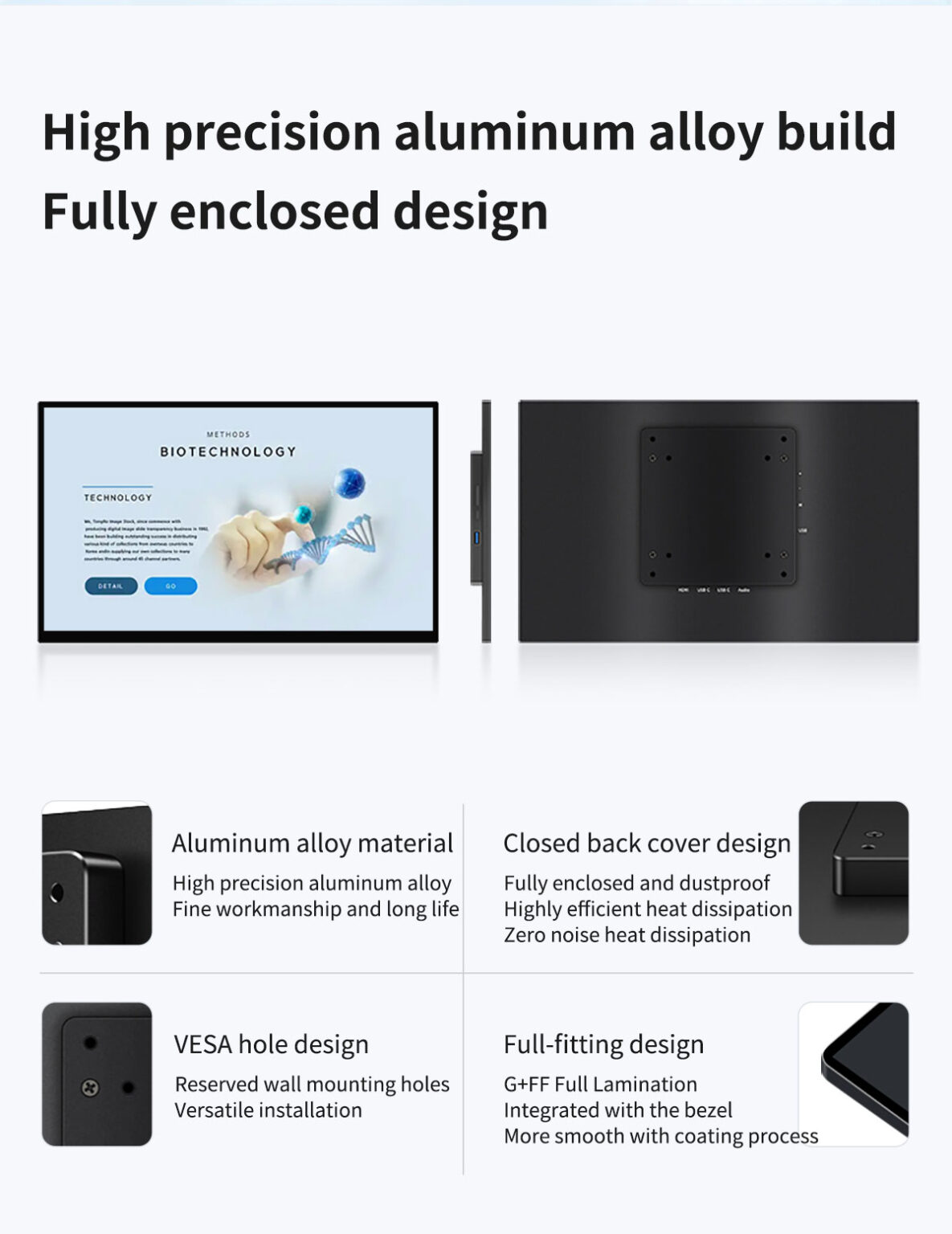
- Medical device integration: Support customized installations involving suitable interfaces, housing, and mounting brackets.
For each application, verify the display’s compatibility with your equipment, operating environment, and applicable regulatory requirements before deployment.
How to Select the Right 4K Medical Display
Follow these steps to narrow down the appropriate configuration for your project.
- Define the application. Identify whether you need general medical visualization, diagnostic image interpretation, surgical visualization, or industrial monitoring.
- Confirm image requirements. Review 4K resolution, contrast, color gamut, brightness, and the required grayscale performance.
- Check integration interfaces. Confirm signal inputs, mounting dimensions, housing requirements, and compatibility with your existing equipment.
- Evaluate protection and touch options. Determine whether EMI protection, the IP45 enclosure, and optional capacitive touch meet your operating conditions.
- Request technical documentation. Ask for calibration data, interface specifications, environmental test results, and applicable certification documents.
- Validate the complete system. Test the display with your actual hardware and software before approving it for production or clinical use.
Why Work with Shenzhen Weichensi Technology Co., Ltd.?
Shenzhen Weichensi Technology Co., Ltd. specializes in the research, development, and production of display terminal devices, with nine years of industry experience according to its company information.
Its product portfolio includes portable monitors, medical monitors, industrial monitors, industrial all-in-one computers, Android all-in-one computers, and advertising all-in-one systems. The company reports more than 13 product certifications, six authorized patents, and 64 global partners.
Weichensi also describes a production system covering product design, solution development, manufacturing, and assembly. For OEM or equipment integration projects, you can discuss customized interfaces, housing, touch configurations, and mounting brackets with the company. Request the relevant technical documents to confirm which specifications and certifications apply to your selected model.
FAQ
1. What is a 4K Medical Display used for?
A 4K Medical Display presents high-resolution visual information in medical imaging equipment, surgical visualization systems, laboratories, and other healthcare applications. Its suitability for diagnostic use depends on calibration, system validation, and applicable requirements.
2. Does this OLED medical monitor support DICOM?
Yes. The product specifications state that it supports DICOM grayscale compliance. If you require diagnostic-grade performance, request documentation confirming calibration and compliance with the specific grayscale standard required for your workflow.
3. Can the display be customized for medical equipment?
The product information identifies customizable interfaces, housing, touch options, and mounting brackets. Contact Weichensi to confirm available configurations, technical compatibility, minimum order quantities, and production lead times for your project.
Conclusion
The 4K Medical Display from Shenzhen Weichensi Technology Co., Ltd. combines Samsung OLED technology, 3840 × 2160 resolution, a 1,000,000:1 contrast ratio, 100% DCI-P3 color gamut, and DICOM grayscale support. Optional touch functionality, EMI protection, and an IP45-rated enclosure provide additional features for medical and industrial integration. Evaluate these specifications against your imaging workflow, calibration requirements, and equipment interfaces before making a purchasing decision.
Looking for a 4K OLED medical display for your next project? Contact Shenzhen Weichensi Technology Co., Ltd. to request detailed specifications, interface options, customization information, and applicable compliance documentation for your intended application.



Add comment